
Review · SELF-GUIDED TOURS
Glasgow Private Self-Guided Tour
Glasgow tells its story in stone and paint. This inexpensive walking tour links the medieval cathedral and Necropolis with Merchant City, George Square, modern murals, university buildings, and Buchanan Street. I like the mix of old Glasgow and street art, and I like the freedom to stop for lunch, a dram, or a closer look whenever you wish. The main catch is the app: you must manage the map and audio yourself, and some users found the navigation and sound quality frustrating.
At $12.37 per person, this is a low-cost way to get your bearings in central Glasgow. It is not a guided walk with a person waiting at the cathedral. You receive three weeks of access to an app, with audio from Alex, directions, photographs, videos, and background information. If you expect a live guide, this is the wrong product. If you enjoy setting your own pace, it can be a useful introduction.
In This Review
- Key points to know before you go
- Starting beside Glasgow Cathedral
- Walking among Glasgow’s grand dead
- Provand’s Lordship and Glasgow’s oldest-looking corners
- Strathclyde University and a city painted on its walls
- Merchant City, tobacco wealth, and old burial ground
- George Square and the civic heart
- Art galleries, Mackintosh design, and Buchanan Street
- The Lighthouse and the final murals
- How the app works in real use
- Timing, pace, and value at $12.37
- Who should book this Glasgow walk?
- Should you book the Glasgow Private Self-Guided Tour?
- FAQ
- Is this a live guided tour?
- Where does the Glasgow tour start?
- Where does the tour finish?
- How long does the tour take?
- What language is available?
- What do I need to use the tour?
- Are entrance fees included?
Key points to know before you go
- Start at Glasgow Cathedral: Begin with one of the city’s finest medieval buildings, then walk into the Necropolis beside it.
- Street art gets equal billing: Several murals, including works by Smug, give the route a modern Glasgow voice.
- The route covers major central sights: You pass Strathclyde University, Merchant City, George Square, the City Chambers, Buchanan Street, and The Lighthouse.
- The app needs your attention: Audio may not start on its own, and some users had to switch between the narration and map.
- Plan for more than two hours if you like stops: The stated time is about two to three hours, but one leisurely outing took around five hours with food and drink breaks.
- There is no live guide: Only your own group participates, and entrance charges for attractions are not included.
Starting beside Glasgow Cathedral
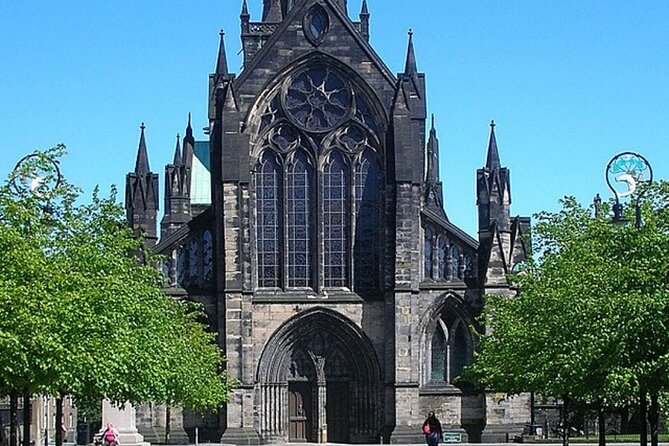
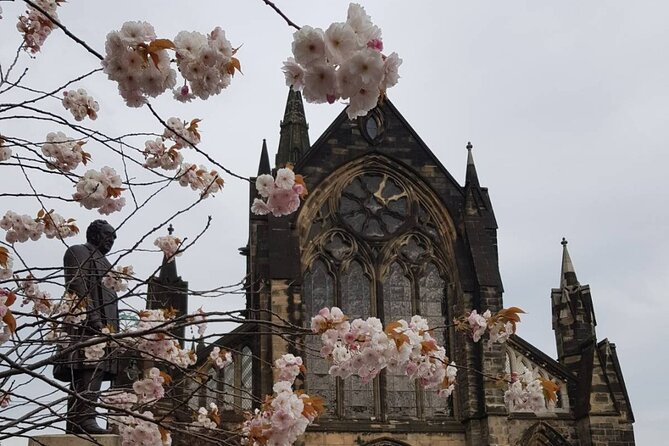
The tour begins outside Glasgow Cathedral on Castle Street. This gives you a strong opening chapter because the building connects modern Glasgow to its medieval beginnings.
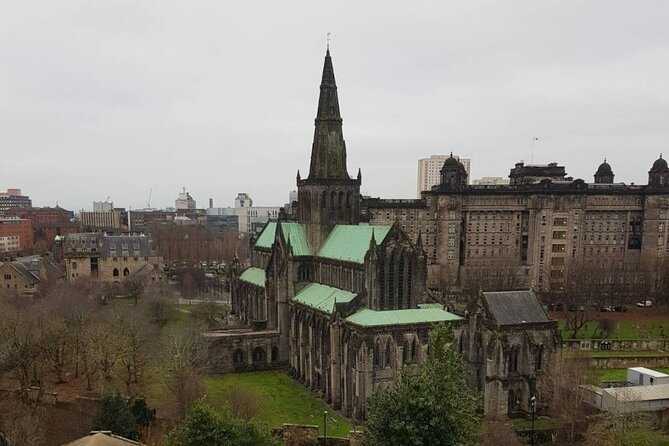
The present cathedral dates from 1197, after the first building was badly damaged by fire soon after its construction in 1136. The important point is that the cathedral has remained roofed and in use for more than 800 years. That continuity is easy to appreciate as you walk through the area.
The audio commentary introduces the cathedral and its place in Glasgow’s story. The stop is scheduled for about 30 minutes, though you can spend longer if the building is open and you want to look carefully. Admission is listed as free, but opening arrangements can change, so treat the interior visit as a bonus rather than the sole reason to book.
I like beginning here because the tour does not rush straight into shopping streets. You first meet Glasgow as an old church city, then watch the route move through trade, civic power, art, and present-day city life.
More Glasgow trips:
- Guided Celtic Park Stadium Tour
★ 5.0 · 3,136 reviews - City Sightseeing Glasgow Hop-On Hop-Off Bus Tour
★ 4.5 · 1,873 reviews - Oban, Glencoe, Highlands Lochs & Castles Small Group Day Tour from Glasgow
★ 5.0 · 1,432 reviews
Walking among Glasgow’s grand dead
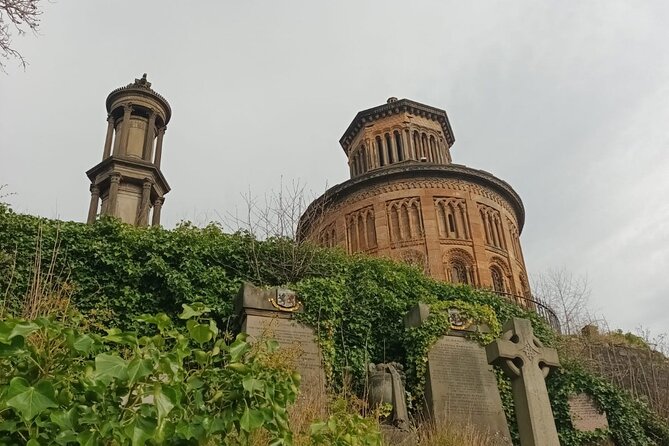
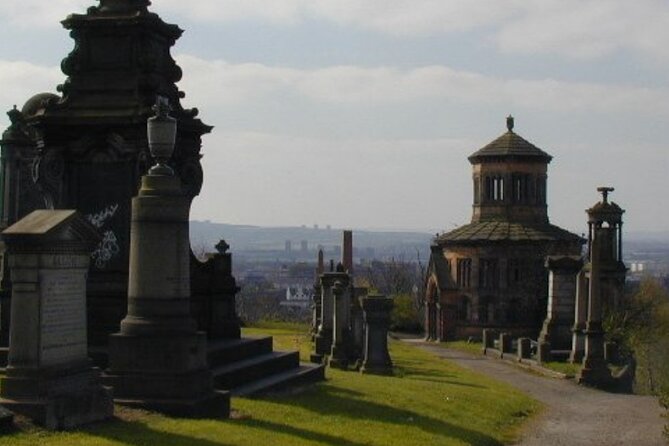
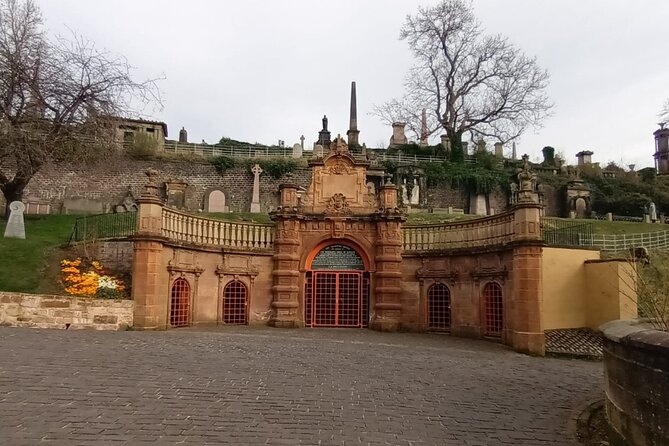
Next comes the Glasgow Necropolis, one of the city’s most striking open-air sights. It began in 1831, inspired by Père Lachaise in Paris, and covers about 37 acres. That is roughly 15 football fields, or around 150,000 square metres.
The Necropolis was designed during a period when wealthy Glasgow residents wanted impressive memorials. You can expect monuments, tombs, slopes, and broad views across the city. The appeal is not only the graves themselves. The setting shows how merchants and civic leaders used architecture to express status after death.
The scheduled stop is only 15 minutes, which is enough for an introduction but not enough for a slow walk through the whole site. I suggest allowing extra time if you enjoy memorials, architecture, or city views. The route gives you a reason to enter, but you remain free to explore at your own pace.
This is also one of the places where comfortable shoes matter. The entire tour is on foot, and a historic graveyard spread across 37 acres is not a quick indoor stop.
Provand’s Lordship and Glasgow’s oldest-looking corners
The route continues toward Provand’s Lordship, a stone building known by that name since the late nineteenth century. Before that, it was called the Hospital of St Nicholas.
The commentary uses the building to show how Glasgow’s civic and religious functions changed over time. The itinerary does not give a separate time allowance for this stop, so you will likely hear about it as part of the walk between the cathedral area and the city centre.
This section works best if you pay attention to the transitions. Glasgow’s oldest sights are not placed in a museum zone with everything neatly separated. You move through ordinary streets and see how medieval, Victorian, commercial, and modern parts of the city sit close together.
Strathclyde University and a city painted on its walls
At the University of Strathclyde, the focus shifts to architecture and murals. The university is one of Glasgow’s three major universities, and the stop takes about 15 minutes.
The tour treats the campus as more than an academic setting. You are shown buildings and several pieces of street art, linking Glasgow’s educational life with its current art scene. This is useful because a standard city walk might mention the university only in passing.
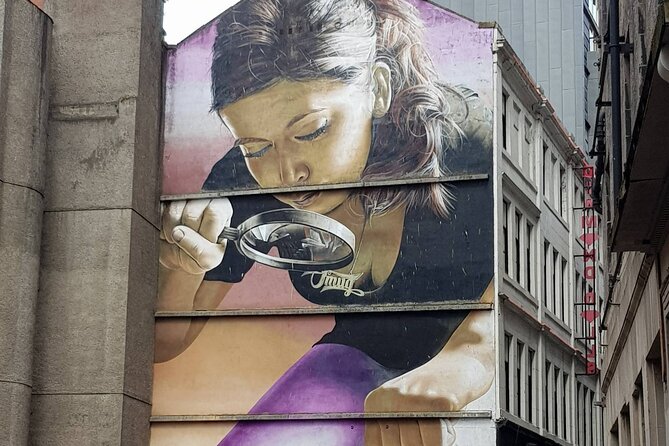
Murals appear at several points along the route. Glasgow has used large wall paintings to revive neglected walls and gable ends, while also changing how people view street art. The result is a route where painted walls are not random decoration. They are part of the city’s effort to present its culture in public spaces.
One short stop features the St Enoch cradling St Mungo mural. It shows a mother holding a baby in a futuristic version of St Mungo, Glasgow’s patron saint. The five-minute commentary explains the mural and the saint who inspired it.
You also pass Fellow Residents of Glasgow by Smug. A hiker foraging for mushrooms appears in a fairy-tale woodland scene, with animals that can be found in Glasgow’s parks and green spaces. The animals seem to appear through holes in the wall, giving the work a playful effect without losing its connection to local nature.
The final Smug mural is Honey, I shrunk the Kids, described as photo-realistic street art. These works give the walk a clear theme: Glasgow’s character is found not only in grand buildings but also on blank side walls.
More Self-Guided Tours in Glasgow:
- Glasgow Ghost Hunt: The Soul That Got Away Exploration Game
★ 4.0 · 71 reviews - Glasgow Scavenger Hunt and Highlights Self Guided Audio Tour
★ 5.0 · 1 review - Cycle To Loch Ness – Self Guided
★ 5.0 · 119 reviews - Harry Potter’s Edinburgh: A Self-Guided Audio Tour
★ 4.5 · 42 reviews
Merchant City, tobacco wealth, and old burial ground
The route’s fifth named stop is 98 Ingram Street. Here, you see a church built in 1824 in the Gothic Revival style by English architect Thomas Rickman. The graveyard contains the graves of tobacco merchants Andrew Buchanan and John Glassford.
This stop opens a useful window onto Glasgow’s eighteenth-century wealth. The older Ramshorn cemetery, now partly covered by Ingram Street, was once an expensive and fashionable burial place before the Necropolis took over that role.
The scheduled time is five minutes, but the subject deserves more. Look at the relationship between the church, cemetery, and surrounding commercial streets. The city’s trade wealth was not abstract. It paid for buildings, shaped burial customs, and left names on the urban map.
You then encounter a statue of Mercury, the Roman god associated with commerce, travellers, luck, trickery, and thieves, among other things. It sits on a marble plinth and is one of two Mercury sculptures by Alexander Sandy Stoddart. The statues represent Glasgow’s Italian quarter of Merchant City.
That mix of commerce and humour is typical of the route. You get facts, but you also get small details that make the streets easier to remember.
George Square and the civic heart
The City Chambers were completed in 1888 and opened by Queen Victoria. The building sits near George Square, where Victoria is also honoured with a statue at the opposite end.
George Square takes its name from King George III. It was laid out as early as 1781 as part of a plan for a Georgian grid, though the square itself was not developed for another 20 years.
The commentary points out details that connect Glasgow with wider British popular culture, including the use of the City Chambers as a registry office setting in a famous television series. The specific reference is offered as a guessing game, which may appeal if you enjoy spotting film and television locations.
This part of the walk is useful for understanding Glasgow’s civic confidence. The square and chambers present the city as a major commercial and political centre, while the nearby murals and shops show how that identity has changed.
Art galleries, Mackintosh design, and Buchanan Street
The itinerary also includes a major Glasgow gallery, though its name is not specified in the supplied details. The tour promises background on this important city attraction, but you should check the audio and route information in the app for the exact stop.
There is also a stop connected with Mackintosh-inspired tea rooms. The establishment dates from 1983, while its interior draws on Charles Rennie Mackintosh and its design is modelled on Kate Cranston’s Ingram Street tea rooms from the early 1900s.
This is a fine example of how Glasgow reuses its design heritage. Charles Rennie Mackintosh is one of the city’s best-known artists and architects, but the tour does not confine him to a museum. You encounter his influence in a functioning tea-room setting.
The named stop on Buchanan Street lasts about 10 minutes. By this point, the walk has moved from the medieval cathedral to today’s central shopping and commercial district. The route gives you a simple timeline: church and saint, merchants and memorials, civic buildings, art, and present-day city life.
The Lighthouse and the final murals
The Lighthouse is a visitor centre, exhibition space, and event venue in central Glasgow. It is associated with the city’s design story and provides another connection to Mackintosh.
The information supplied does not state whether entry to any exhibition is included, and the tour clearly excludes entrance fees for attractions. Check before entering if you want to visit beyond the exterior or audio stop.
The route finishes near St Enoch subway station, close to the Roman Fort. This ending is practical. You finish in a central area with public transport nearby rather than being left at an isolated viewpoint.
The closing location also brings the route full circle. You began beside the cathedral, one of Glasgow’s oldest surviving symbols, and end near St Enoch, a name tied to St Mungo’s mother, Thenew, also known as Saint Enoch.
How the app works in real use
After booking, you receive an email with instructions to activate the tour. Your booking reference is not the activation code, so read the instructions carefully. You must download the Pandemic Tours app before setting out.
The package includes a GPS route, map, directions, stop information, photographs, videos, recommendations, and three weeks of unlimited access. The audio is presented by a real narrator rather than a computer-generated voice. Alex is associated with the Glasgow commentary, and one particularly positive assessment praised her voice and the level of detail. Another praised Katie’s thorough historical explanations.
The weak point is operation. The narration may not start automatically, and you may need to leave the audio screen to use the map. Some users found that the app lost their place when switching between screens. Another complaint concerned low audio volume and recording quality.
I recommend testing the app before you reach the cathedral. Make sure the route loads, your phone has enough power, and you know how to restart a stop. The tour does not reliably guide you from one stop to the next by voice, so you need to watch the map.
Timing, pace, and value at $12.37
The stated duration is two to three hours. That seems reasonable for walking between the listed points without long visits inside attractions. I would not treat it as a strict schedule, though.
One person completed the route in about five hours by stopping for lunch, drinks, and side looks. That is the real advantage of a self-guided walk. You can pause when a building catches your eye, spend longer in the Necropolis, or stop in Merchant City without holding up a group.
At $12.37 per person, the price is attractive if you want orientation and background rather than a full live tour. The cost is especially easy to justify for solo visitors or small private groups, since only your group takes part. You are paying for access to the route and content, not personal conversation or on-the-spot answers.
The value drops if you want a polished hands-free experience. A live guide would handle directions, timing, and questions. Here, you must supply those parts yourself. The ticket price also does not include entrance fees, though several listed outdoor stops are free.
Who should book this Glasgow walk?
I would choose this tour if you like independent sightseeing, want a clear route through central Glasgow, and enjoy both architecture and murals. It is also a good fit if you have only a few hours and want to cover many highlights without committing to a fixed group departure.
Solo visitors can benefit from the flexible format, and couples or families may appreciate having the route to themselves. The three-week access period also gives you room to split the walk across more than one outing, although the advertised walking time is only two to three hours.
I would hesitate if you expect a person at Glasgow Cathedral, automatic turn-by-turn narration, or museum-quality audio. The app problems are not minor for someone who wants to put the phone away and simply listen.
The route itself is stronger than the technology. The combination of cathedral, Necropolis, university, murals, Merchant City, George Square, and Buchanan Street gives you a broad look at Glasgow. The audio quality and navigation are the parts most likely to affect your enjoyment.
Should you book the Glasgow Private Self-Guided Tour?
Book it if you want a cheap, flexible introduction to Glasgow and are comfortable using a map on your phone. I especially like it for a first afternoon in the city, when you want to understand how the old cathedral quarter connects with the commercial centre.
Skip it if the phrase private tour makes you expect a private guide. This is a private self-guided activity, not a personal walking tour. Download the app early, test the audio, bring a charged phone, and allow extra time for the Necropolis, food, and unexpected stops. With those expectations in place, $12.37 buys a useful route through a city that rewards looking up, slowing down, and noticing the painted walls.
FAQ
Is this a live guided tour?
No. It is a self-guided tour, and only your group participates. The app provides audio, directions, maps, videos, photographs, recommendations, and stop information.
Where does the Glasgow tour start?
It starts at Glasgow Cathedral on Castle Street, Glasgow G4 0QZ.
Where does the tour finish?
The tour finishes at St Enoch Subway Station in Glasgow, near the Roman Fort.
How long does the tour take?
The stated duration is approximately two to three hours. You can take longer if you stop for food, drinks, sightseeing, or extra time at the Necropolis.
What language is available?
The tour is offered in English.
What do I need to use the tour?
You must download the Pandemic Tours app after booking. You will receive an email explaining how to activate the tour, and the booking reference is not the activation code.
Are entrance fees included?
No. Entrance fees for attractions mentioned during the tour are not included. Several outdoor stops, including Glasgow Cathedral and the Necropolis, are listed with free admission.
Just added in Glasgow
- Stirling to Glasgow Luxury Car Transfer★ 5.0 · 1 review
- Day Tours & Shore Excursions Glasgow, Greenock & across Scotland★ 5.0 · 21 reviews
- Glasgow Greenock Shore Excursion Highland Lochs, Castles & Glens★ 5.0 · 6 reviews
- Glasgow Shore Excursions (Princess & Norwegian Cruise Ships)★ 5.0 · 2 reviews
- Glasgow; Glencoe, Oban & Highlands Private 11 Hour Tour★ 5.0 · 2 reviews
- Glasgow Luxury Private Day Tour with Scottish Local★ 5.0 · 2 reviews
- Glasgow Airport (GLA) to St Andrews Luxury Transfer★ 5.0 · 1 review
- Glasgow Airport to City Mercedes Minivan★ 5.0 · 1 review
Self-Guided Tours, compared.
Glasgow Ghost Hunt: The Soul That Got Away Exploration Game
Read our review →
Harry Potter’s Edinburgh: A Self-Guided Audio Tour
Read our review →
500 Years of Crime and Punishment: A Self-Guided Audio Tour
Read our review →
Ghosts of Edinburgh: Bloody Past Exploration Game and Tour
Read our review →
The Dark Side of Aberdeen: A Self-guided Audio Walk
Read our review →
Also on these Scottish lists