
Review · HISTORICAL TOURS
The Magnificent and Mysterious History of Glasgow
Glasgow keeps its best stories on the street. This compact walk links grand civic buildings, medieval lanes, statues, music halls, murals, and Glasgow Cathedral while giving you a quick feel for how the city grew. I especially like the wide range of sights and the way local stories add a slightly scandalous edge to the past. The main drawback is the pace: you cover a lot, and some key stops may be affected by construction or private events.
The tour costs about $17.91 per person, which is strong value for roughly two to two and a half hours with a guide. Guides such as Bruce and Henry Bell have earned praise for humor, clear storytelling, and local detail. You should be ready to walk for 40 to 45 minutes between sights, listen closely in a group of up to 15, and allow extra time if the tour runs beyond the shorter advertised duration.
In This Review
- Glasgow in one walk: key points
- Starting with Glasgow’s grandest address
- Merchants, mansions, and Glasgow’s self-image
- Merchant City’s working side
- Fruitmarket, Trongate, and Glasgow’s artistic streak
- The world’s oldest surviving music hall
- High Street and Glasgow’s oldest surviving buildings
- Glasgow Cathedral: the strongest finish
- How the timing and group size affect the experience
- Is $17.91 good value?
- Who should book this Glasgow walking tour?
- Should you book it?
- FAQ
- Where does the tour start?
- Where does the tour end?
- How long does the tour last?
- How much walking is involved?
- What language is offered?
- What is the maximum group size?
- Is the tour suitable for most people?
- Does the price include admission tickets?
- Can the tour be canceled because of weather?
- What is the cancellation deadline?
Glasgow in one walk: key points
- George Square opens the story: City Chambers, the war memorial, and statues of Walter Scott and Robert Burns explain how Glasgow presented itself in the 19th century.
- The route mixes grand and odd: You move from merchant mansions and civic halls to Paesano Pizza, a traffic-cone-topped duke, and an old music hall.
- Glasgow’s medieval core comes late: High Street, Mercat Cross, Provand’s Lordship, and Glasgow Cathedral reveal the city’s oldest surviving streets and buildings.
- Local guides make the difference: Bruce and Henry Bell are praised for humor, clear explanations, poems, quirky facts, and strong local knowledge.
- The walk is good for orientation: It covers Merchant City and the historic center, helping you choose where to return for a closer look.
- Plan for weather and timing: The tour requires suitable weather, includes substantial walking, and has a stated maximum of 15 people.
Starting with Glasgow’s grandest address
Meet at George House, 50 George Square. The opening section focuses on the square and its monuments, so you begin with a useful lesson in civic Glasgow rather than rushing straight into a long march.
City Chambers is the visual showstopper. It houses Glasgow City Council and carries sculpture and decoration that reveal how 19th-century Glaswegians wanted their city understood. You get about 10 minutes here, enough to hear why the building matters and to look up at details you could easily miss alone.
The Glasgow War Memorial follows. It honors citizens killed in the First World War and is presented as a marker of change in the city’s story. The stop lasts only four minutes, but its meaning helps shift the tour from civic pride toward the human cost of Glasgow’s growth.
George Square’s statues then bring in two major Scottish figures. Sir Walter Scott’s monument is the square’s centerpiece and reflects the way Scotland’s national identity was shaped in the 19th century. Robert Burns gets a shorter stop, but his statue has a fine democratic detail: it was funded through small public contributions, with thousands giving as little as five pence. About 30,000 people attended its unveiling.
This opening hour can feel slow if you mainly want to walk. That is also its strength. One person found the time in George Square puzzling at first, then understood why the guide began with the city’s basic story. If you prefer context before monuments, stay with it.
More Glasgow trips:
- Guided Celtic Park Stadium Tour
★ 5.0 · 3,136 reviews - City Sightseeing Glasgow Hop-On Hop-Off Bus Tour
★ 4.5 · 1,873 reviews - Oban, Glencoe, Highlands Lochs & Castles Small Group Day Tour from Glasgow
★ 5.0 · 1,432 reviews
Merchants, mansions, and Glasgow’s self-image
The next part explains who paid for Glasgow’s expansion and how the city’s commercial class wanted to be seen.
Merchant’s House offers a window into the power of Glasgow’s merchants. Their work helped build the city’s prosperity, and the building’s position in the center tells you something about their importance. This is not simply an old house to photograph. It gives the tour a chance to discuss money, trade, status, and the people who shaped modern Glasgow.
The Gallery of Modern Art adds a sharp change of mood. The building began as a private mansion and later passed through several uses before becoming a gallery. That change is typical of the route: Glasgow’s buildings often carry several chapters, not one tidy purpose.
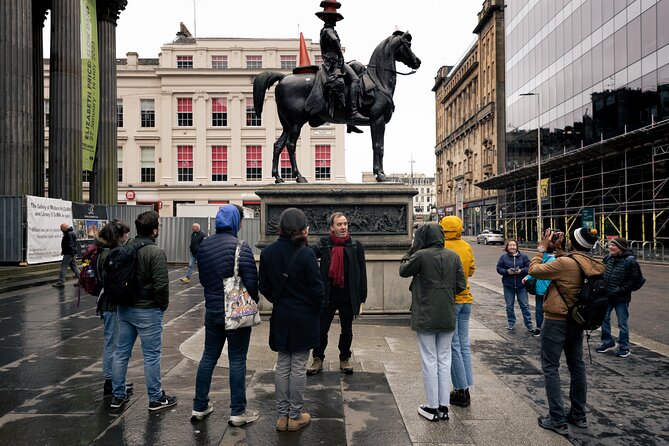
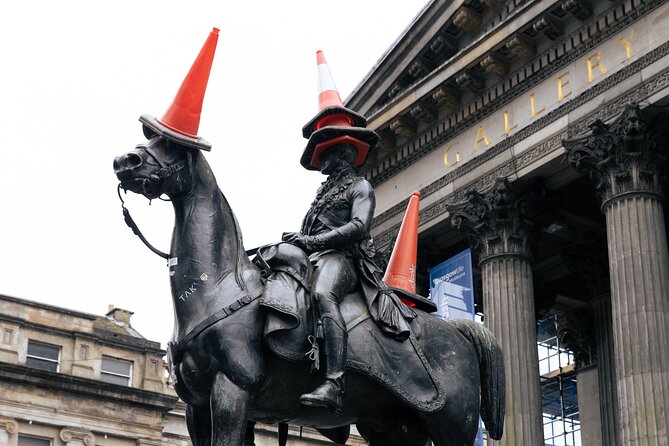
Then comes the Duke of Wellington statue, one of the city’s most recognizable sights. Wellington was a decorated military leader and a prime minister, but many people know the statue for the traffic cone regularly placed on his head. It is a wonderfully Glasgow moment: official grandeur meets public mischief.
The brief stop at Paesano Pizza keeps that humor going. This is one of the city’s popular pizza restaurants, but the tour uses it as a doorway into an unusual past job opportunity. The detail is quick, yet it shows how the walk works best when ordinary places are given a backstory.
There is also an 18th-century Georgian townhouse in the modern city center, tied to an original family with an interesting story. The supplied route does not name the building or give a longer stop time, so you should treat it as a passing story rather than a full interior visit.
Merchant City’s working side
Trades Hall of Glasgow shifts attention from wealthy merchants to organized tradespeople. Carpenters, tanners, dyers, and other workers were represented here, and the Trades House supported members who had become too old to work.
That social role matters. You are not just looking at another historic facade. You are hearing how Glasgow’s guilds and trade groups cared for their own members before modern welfare systems existed.
The route then reaches a medieval street associated with candle makers. They worked apart from the old town because of the danger of fire. Later, the area became a place for markets and warehouses, and today it forms part of Glasgow’s cultural district. The story is a neat example of how one street can move from craft production to commerce to culture.
The Corinthian Club adds another layer of reuse. The building has served as a bank, courthouse, and county building. It is now a prominent club and wedding venue. You can see why this is a useful stop for anyone interested in architecture: the city’s past is not sealed away. It is often wrapped around present-day businesses.
The Saints of Ingram stop brings together three old Glasgow institutions: the Merchants House, the Trades House, and Hutcheson’s Hospital. Together they were described as three graces of Glasgow because they helped care for citizens over many years. This is one of the tour’s better points for understanding civic responsibility, charity, and status in the old city.
Fruitmarket, Trongate, and Glasgow’s artistic streak
City Halls and the Old Fruitmarket show you a former commercial center. The Old Fruitmarket was once busy with trade, and the structure remains accessible even though its use has changed to retail. You can walk through and picture the role it played in working Glasgow.
Trongate 103 brings the route into the city’s arts scene. It houses several attractions, including the Sharmanka Kinetic Gallery. The stop is listed for about 10 minutes, giving the guide room to point out the cultural side of central Glasgow rather than treating the city only as a collection of old stones.
This is also where the tour’s broad range can work against it. You see many subjects, but the walk cannot give each one a full explanation. One critical assessment found that the route sometimes felt like a series of stops rather than a connected argument about Glasgow’s art, religion, politics, and trade.
That is fair. I would approach this as an orientation walk with stories, not a university lecture. You will gather many useful threads and get ideas for later visits. If you want one theme explored in depth, a more focused tour may suit you better.
More History Tours in Glasgow:
- Glasgow: Pubs & History Walking Tour with Beer Tasting
★ 5.0 · 81 reviews - West of Scotland Cultural Tour
★ 5.0 · 7 reviews - Old Town Walking Tour History and Tales in Edinburgh
★ 5.0 · 2,168 reviews - Old Town Historical and Underground Tour
★ 5.0 · 1,574 reviews
The world’s oldest surviving music hall
Britannia Panopticon Music Hall is one of the route’s most distinctive stops. It is described as the world’s oldest surviving music hall, and a young Stan Laurel performed here before becoming one half of the famous comedy duo.
The stop lasts about five minutes, so do not expect a long performance or a full guided visit. The value is in the setting and the connection to popular entertainment. It takes you away from official monuments and into the city’s rougher, more theatrical public life.
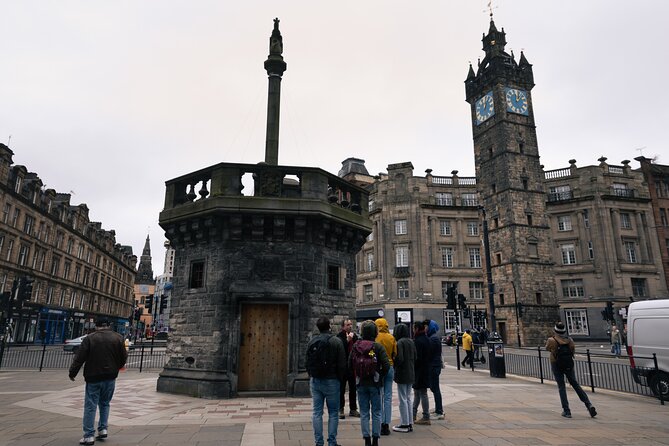
Mercat Cross follows. The present structure recreates a medieval market cross, the place where proclamations were made. It helps you picture how news, law, and public authority reached people before newspapers and modern communication.
These short stops are especially useful if you enjoy odd facts. Guides Bruce and Henry Bell have been praised for adding quirky details without losing the main story. Bruce, in particular, is credited with a quick pace, good humor, and facts that make the city easier to remember.
High Street and Glasgow’s oldest surviving buildings
High Street receives the longest outdoor section, about 15 minutes. This was the heart of medieval Glasgow, and the road links several important pieces of the city’s past.
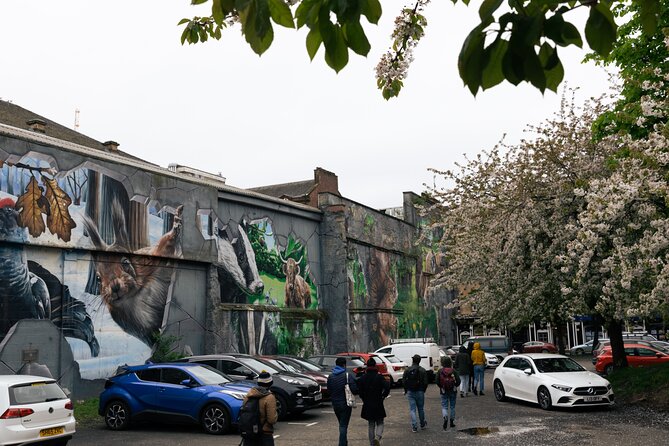
You hear about the site of the old University, described as the fourth oldest in Britain. You also see two major murals connected with St Mungo, Glasgow’s patron saint, along with other notable buildings.
St Mungo becomes increasingly important as the route moves east. Several guides have used his stories and miracles to explain why he remains central to Glasgow’s identity. If you arrive knowing little about him, this part gives you a useful key to the city’s symbols.
The David Livingstone statue adds one of Scotland’s great explorers to the route. It originally stood in George Square, so the statue also tells a small story about how public monuments move and how a city changes its priorities.
Ramshorn Theatre occupies a building opened in 1824, replacing an earlier church. Many prominent Glaswegians were buried on the site. In more recent years, it served as a theatre and now belongs to the University of Strathclyde as a center for language studies.
The Friends of Glasgow Royal Infirmary Museum stop points to Glasgow’s medical past. This is the city’s oldest hospital, and many medical advances were pioneered there. The stop is brief, only about three minutes, but it widens the tour beyond politics, religion, and architecture.
Glasgow Cathedral: the strongest finish
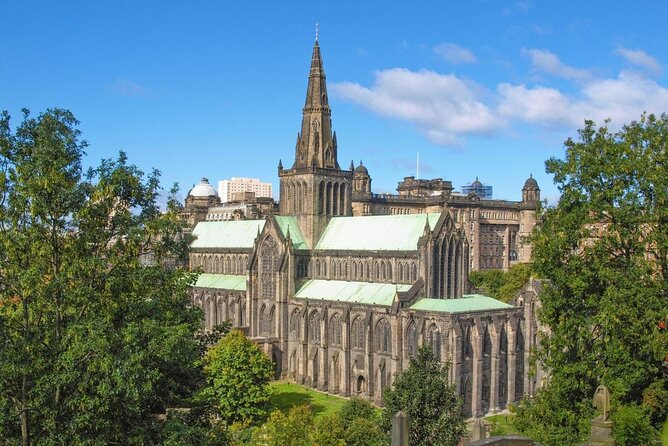
Glasgow Cathedral is the emotional high point for many people. The current building dates to the 13th century, but a church has occupied the site since the 6th century.
You get about 20 minutes here, the longest stop on the route. That is enough time for a proper look inside, though the visit can be affected by services. One person found the cathedral closed to the tour because of a private service, so keep your expectations flexible.
The cathedral matters because it ties together nearly everything that came before: St Mungo, medieval Glasgow, religion, civic power, and the city’s long development. The guide’s explanation can turn a quiet church visit into a clear lesson in why this place shaped Glasgow.
Nearby Provand’s Lordship is another major survival from old Glasgow. It dates to the 14th century and is one of the city’s oldest buildings apart from the cathedral.
The final stop is the St. Mungo Museum of Religious Life and Art. Its building was designed to look much older, and its subject is the range of religions practiced around the world today. It makes a thoughtful ending, linking Glasgow’s early Christian story with a wider view of faith.
The route information gives the official end as 98 Ingram Street, outside Ramshorn Church, not far from George Square. Because the listed sights continue through the cathedral and museum area, the exact walking order may vary. Check the meeting instructions on the day and do not schedule a tight connection immediately afterward.
How the timing and group size affect the experience
The stated duration is inconsistent. The main timing is about 2 hours and 4 to 14 minutes, while the additional information says the walk lasts approximately 2 hours and 45 minutes. Walking between attractions takes around 40 to 45 minutes, and the route includes many short explanations.
In practical terms, plan for at least two and a half hours. The guide may wait briefly if someone is late or steps away, and one tour reportedly ran about 30 minutes beyond the expected finish. That is not ideal if you have a train, meal booking, or another timed activity.
The maximum group size is 15. That is reasonably small for a city walk, but hearing can still be difficult when the group gathers near traffic or crowded streets. One person felt a smaller group would have been worth paying extra for.
Wear comfortable shoes and bring weather protection. The experience requires good weather, and Glasgow rain can make a long outdoor explanation less pleasant. Service animals are allowed, public transport is nearby, and most people can take part.
Is $17.91 good value?
At $17.91, I consider this a good-value introduction to Glasgow. You get a guide, a route through Merchant City and the historic center, stories at more than 20 points, and a useful first look at the cathedral area.
The value is highest if you are new to Glasgow or staying near Merchant City. The walk helps you get your bearings and shows you where to return for more time. It also covers free public sights, so you are paying for interpretation rather than entry tickets.
The price buys breadth, not depth. You will not receive a full architectural study of every building, and short stops at places such as Paesano Pizza, the infirmary museum, and the David Livingstone statue are mainly story points.
The tour has a 4.8 rating from 49 reviews, with 96 percent recommending it. The strongest praise centers on the guides’ humor, warmth, storytelling, and local knowledge. Bruce is frequently singled out, while Henry Bell is praised for clear, entertaining explanations. Guide quality can vary by date, but the pattern is encouraging.
Who should book this Glasgow walking tour?
I would choose this tour if you want a lively first look at Glasgow and enjoy history told through buildings, statues, and strange local details.
It suits you especially well if:
- You are staying in or near Merchant City.
- You want to see many central sights without planning the route yourself.
- You like architecture but also want stories about trade, religion, entertainment, and civic life.
- You are happy walking at a fairly quick but comfortable pace.
- You want help deciding which places deserve a longer visit.
I would hesitate if you dislike group walking, need a precise finish time, or want a slow and highly focused treatment of one subject. The route covers a lot, and one critic felt the links between Glasgow’s art, religion, trade, and politics needed more attention.
Should you book it?
Yes, if you want a good first-day overview at a modest price. The mix of City Chambers, merchant buildings, the Duke with his cone, Britannia Panopticon, High Street, St Mungo, and Glasgow Cathedral gives you a memorable outline of the city.
Book it early if possible, since it is commonly reserved about 35 days ahead. Leave your afternoon open, wear shoes suited to city streets, and treat the tour as a starting point rather than the final word on Glasgow.
Skip it if you want a quiet, small-group experience or a tightly timed itinerary. For most first-time visitors, though, the combination of strong guides, central sights, and wonderfully odd Glasgow stories makes this an easy recommendation.
FAQ
Where does the tour start?
It starts at George House, 50 George Square, Glasgow G2 1EH, UK.
Where does the tour end?
The stated end point is 98 Ingram Street, outside Ramshorn Church, not far from George Square.
How long does the tour last?
The listed duration is approximately 2 hours and 4 minutes to 2 hours and 14 minutes. Additional information says to expect approximately 2 hours and 45 minutes, so allow extra time.
How much walking is involved?
Walking between the main attractions takes around 40 to 45 minutes. The rest of the time is spent hearing explanations at the stops.
What language is offered?
The tour is offered in English.
What is the maximum group size?
The maximum is 15 participants.
Is the tour suitable for most people?
Yes. The information says most people can participate. Service animals are also allowed.
Does the price include admission tickets?
All listed stops show free admission. The cost is about $17.91 per person for the guided walking experience.
Can the tour be canceled because of weather?
Yes. The experience requires good weather. If poor weather causes cancellation, you will be offered another date or a full refund.
What is the cancellation deadline?
You can cancel at least 24 hours before the start time for a full refund. Cancellations or changes made less than 24 hours before the start are not accepted for a refund.
Just added in Glasgow
- Stirling to Glasgow Luxury Car Transfer★ 5.0 · 1 review
- Day Tours & Shore Excursions Glasgow, Greenock & across Scotland★ 5.0 · 21 reviews
- Glasgow Greenock Shore Excursion Highland Lochs, Castles & Glens★ 5.0 · 6 reviews
- Glasgow Shore Excursions (Princess & Norwegian Cruise Ships)★ 5.0 · 2 reviews
- Glasgow; Glencoe, Oban & Highlands Private 11 Hour Tour★ 5.0 · 2 reviews
- Glasgow Luxury Private Day Tour with Scottish Local★ 5.0 · 2 reviews
- Glasgow Airport (GLA) to St Andrews Luxury Transfer★ 5.0 · 1 review
- Glasgow Airport to City Mercedes Minivan★ 5.0 · 1 review
Historical Tours, compared.
Old Town Walking Tour History and Tales in Edinburgh
Read our review →
Multi-Sensory Small-Group Historic Vaults Tour in Edinburgh
Read our review →
Edinburgh Old Town: Historical Guided Walking Tour
Read our review →

Also on these Scottish lists